
Quick Answer: SCHD’s dividend growth compounds two ways, the fund raises its payout over time, and reinvested distributions buy more shares that generate their own dividends. The strategic advantage most investors miss is using SCHD’s quarterly cash distributions as rebalancing fuel: instead of selling appreciated positions and triggering capital gains, you direct incoming dividends toward whichever sleeve of your portfolio has drifted below target. This turns a passive income stream into a tax-efficient portfolio maintenance tool.
Why SCHD Behaves Differently Than a Yield Chase
The Schwab U.S. Dividend Equity ETF screens for companies with at least 10 consecutive years of dividend payments, then ranks survivors on cash-flow-to-total-debt, return on equity, dividend yield, and five-year dividend growth rate. That screen matters more than the headline yield.
A high-yield fund can deliver a large check today and shrink it tomorrow. A dividend growth fund with a quality overlay is buying balance sheet durability, companies that can fund a rising payout out of operating cash flow rather than leverage. The distinction shows up in drawdowns, when the yield-chasing basket cuts and the quality basket doesn’t.
For portfolio construction purposes, this makes SCHD useful as a value-tilted core equity holding that produces a predictable cash stream, not as a bond substitute. It is still equity. It still carries equity beta. Treating a 3-4% yield as if it were fixed income is one of the more expensive mistakes in retail portfolio design.
The Reconstitution Effect
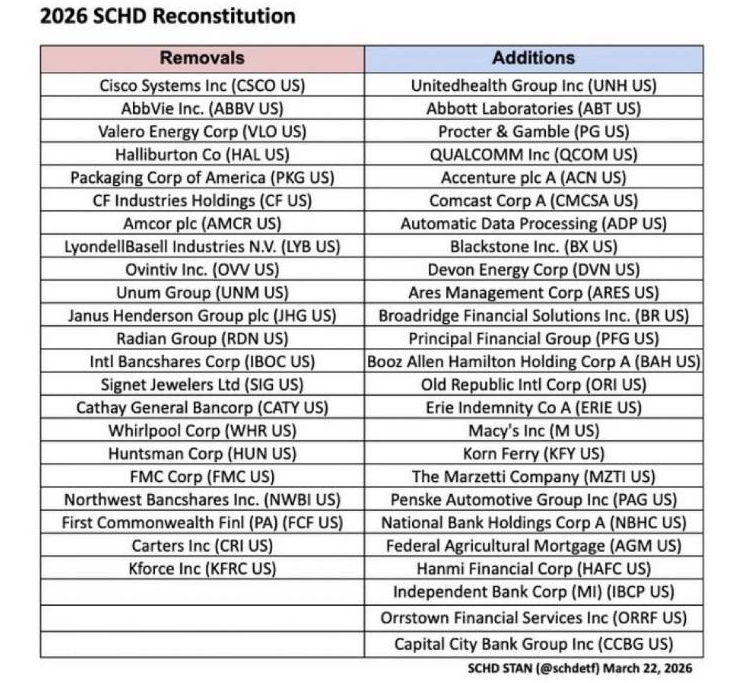
SCHD reconstitutes annually, which means the fund periodically drops names that no longer meet its quality and dividend criteria and adds ones that do. For a buy-and-hold investor, this is the mechanism that keeps the portfolio from slowly degrading into a collection of dividend traps. It also means the fund’s sector composition can shift meaningfully year to year; it is worth checking before you assume your allocation still looks the way it did when you bought.
Earlier this year we discussed the 2026 SCHD reconstitution in detail, below is the summary of ins and outs for SCHD from r/SCHD.
The Two-Engine Compounding Model
Engine one: organic dividend growth. The underlying companies raise their dividends. Your yield on original cost climbs even if you never buy another share. An investor who bought at a 3.5% yield and experiences an 8% annualized dividend growth rate is receiving roughly 7.5% on original cost after ten years, before any reinvestment.
Engine two: reinvestment. Each distribution buys additional shares, which produce additional distributions. This is the classic compounding curve, and its power is entirely a function of time and reinvestment discipline.
Run together, these engines produce a yield-on-cost trajectory that separates dramatically from a static-yield holding over 15+ years. The catch: engine two requires you to actually reinvest, and engine one requires you to hold through the periods where SCHD’s dividend growth lag a momentum-led market, which is exactly when most people sell.
| Static 4% Yield | SCHD’ Dividend Growth | |
|---|---|---|
| Initial yield | 4.0% | 3.5% |
| Annual dividend growth | 0% | 8% |
| Yield on cost, year 10 | 4.0% | ~7.6% |
| Yield on cost, year 20 | 4.0% | ~16.3% |
| Primary risk | Payout cut | Underperformance in growth markets |
Illustrative. Assumes no reinvestment, so the numbers understate total compounding.
Dividends as Rebalancing Fuel: The Core Mechanic
Here’s where SCHD stops being a holding and becomes infrastructure.
Conventional rebalancing means selling what has run up and buying what has lagged. In a taxable account, that sale is a realized capital gain. For a high earner in a state like California, the combined federal and state hit on a long-term gain can approach 33%. Rebalancing becomes something you avoid, which means your allocation drifts, which means your risk profile drifts.
Cash-flow rebalancing solves this. Every quarter, SCHD deposits cash into your account. That cash is already a taxable event, it’s ordinary or qualified dividend income regardless of what you do next. Since you’re paying the tax either way, you get to direct that capital anywhere you want at zero incremental tax cost.
The mechanism:
- Define your target allocation. Say 40% broad market index, 25% SCHD, 20% international, 15% alternatives or fixed income.
- Let dividends accumulate in cash rather than auto-reinvesting into SCHD.
- Each quarter, measure drift. Which allocation is furthest below target?
- Deploy the full distribution there. Not proportionally, concentrated into the most underweight position.
- Repeat.
Over a year, four distributions plus new contributions can absorb a surprising amount of drift without a single sale. You only fall back on selling when the drift exceeds what cash flow can correct, typically after a large, sustained move in one asset class.
When to Turn DRIP Off (and When to Leave It On)
Leave automatic reinvestment on when:
- You’re in a tax-advantaged account where rebalancing is free anyway
- Your portfolio is small enough that quarterly distributions are too small to meaningfully rebalance
- You’re in pure accumulation mode with high contribution rates that handle rebalancing on their own
Turn it off when:
- You hold SCHD in taxable and want the cash-flow rebalancing optionality
- SCHD is at or above its target weight (auto-reinvesting into an overweight position actively worsens your drift)
- You’re managing multiple sleeves and want centralized control over where new capital goes
That second bullet is the one people miss. DRIP on an overweight position is a compounding allocation error, even as it compounds returns.
Placing SCHD Inside a Portfolio
What it contributes: value and quality factor tilt, lower drawdowns than the broad market in most equity corrections, a growing and relatively predictable cash stream, low expense ratio, and qualified dividend treatment for most distributions.
What it doesn’t contribute: international exposure, small-cap exposure, meaningful technology or growth-sector weighting, or any diversification benefit against equity risk generally. SCHD and the S&P 500 both go down in an equity bear market.
This is why SCHD works best as a sleeve within a core. A reasonable framing:
- Passive foundation: broad total-market and international index exposure. This is the part that doesn’t require decisions.
- SCHD sleeve: a deliberate value-and-income tilt, sized to whatever cash flow you actually want to generate.
- Active or alternative layer: whatever you’re using to compress the timeline toward your actual goals.
The right SCHD weight is backed into from the cash flow you want. If you want $500/quarter in rebalancing fuel at a 3.5% yield, that’s roughly $57,000 in SCHD. Start from the output, solve for the position size.
For a full treatment of how these layers fit together and how to size each one against your goals, see our portfolio construction guide, this article assumes that framework and extends it into the cash-flow dimension.
Tax Considerations
The majority of SCHD’s distributions are qualified dividends, taxed at long-term capital gains rates (0%, 15%, or 20% federal depending on bracket) rather than as ordinary income. That’s a meaningful advantage over REIT or high-yield bond income, which is generally taxed at ordinary rates.
But qualified doesn’t mean free. Three things to plan around:
Asset location. In an unconstrained portfolio, tax-inefficient assets belong in tax-advantaged accounts. SCHD sits in an awkward middle, efficient enough to hold in taxable, but generating a forced annual tax liability that a non-dividend-paying index fund doesn’t. If you have both taxable and Roth space and you’re deciding where SCHD goes, the answer depends on whether you want the cash flow accessible now (taxable) or want to eliminate the drag entirely (Roth).
State tax. Qualified dividend treatment is a federal concept. California, among other states, taxes dividend income at ordinary state rates with no preferential treatment. High earners in high-tax states should model the all-in rate, not just the federal rate.
Net investment income tax. The 3.8% NIIT applies above the applicable MAGI thresholds and does apply to dividend income.
The cash-flow rebalancing strategy doesn’t avoid these taxes. It avoids additional taxes, the capital gains you’d otherwise realize by selling to rebalance.
Where This Strategy Breaks Down
Honest assessment of the limitations:
- Small portfolios. Below roughly $100K in SCHD, quarterly distributions are too small to move allocation meaningfully. Your contributions are doing the rebalancing work, not your dividends.
- Extended growth markets. SCHD’s value tilt means multi-year stretches of underperformance versus a cap-weighted index. If you’ll abandon the position during those stretches, don’t take the position.
- Concentration risk. SCHD’s methodology produces meaningful sector concentration that shifts at each reconstitution. SCHD is not a diversified portfolio by itself.
- Dividend focus is not a free lunch. A dollar paid out as a dividend is a dollar no longer compounding inside the business. The case for dividend growth investing rests on the quality screen and the behavioral discipline, not on the dividend itself being superior to retained earnings.
Implementation Checklist
- Set target allocation percentages for every sleeve, written down.
- Size the SCHD position from desired quarterly cash flow.
- Turn off automatic reinvestment in taxable accounts.
- Set a quarterly calendar reminder aligned to distribution dates.
- Each quarter: measure drift, identify the most underweight sleeve, deploy the full distribution there.
- Set a hard drift band (commonly ±5 percentage points) beyond which you’ll sell to rebalance regardless.
- Review after each annual reconstitution to confirm the fund still fits its intended role.