
How to invest your first $100,000, with tax-advantaged account sequencing, asset location strategy, and a realistic allocation framework from a licensed CPA.
Quick Answer
If you have $100K in cash and are wondering where to put it, here’s the short version: you cannot write a check to your 401(k), but you can deploy the cash directly into an IRA ($7,500 for 2026, via backdoor Roth if your income is too high), an HSA if you’re HDHP-eligible ($4,400 self / $8,750 family), and a spousal IRA if married. Then use the paycheck substitution strategy: crank your 401(k)-payroll deferral to the maximum and live off the $100K cash to replace the smaller paychecks.
Everything left flows into a taxable brokerage account with proper asset location, broad-market ETFs in taxable, bonds and REITs in tax-deferred, highest-growth assets in Roth. A 5–10% allocation to alternatives fills out the modern portfolio, but only once you’re free of high-interest debt.
The rest of this article breaks down the full strategy, the math behind it, and the specific allocations to consider.
Why $100K Is a Big Milestone
Hitting $100K invested is a meaningful financial milestone. Not because the number is magic, it isn’t. The milestone matters because it signals that someone is on an upward financial trajectory.
At $100K invested, a 7% average annual return produces $7,000 of portfolio growth per year, before you contribute another dollar. For most people, that’s the first time your money is generating more than you can save in a full year. The math of compounding starts pulling harder than your paycheck pushes. That’s the inflection point.
But $100K also introduces complexity that didn’t exist when your portfolio was $10K or $50K. At smaller balances, nothing matters except “keep buying the index fund.” At $100K, your allocation matters. Tax efficiency matters. Account location matters. A mistake at this level costs real money.
This guide walks through how to actually deploy $100K as a US investor — covering the tax-advantaged accounts to fund first, the asset location decisions that quietly add 0.5–1% to your annual after-tax return, and the allocation frameworks that make sense at this level of wealth.
Step 0: Clear the Runway First
Before deploying a dollar into investments, two prerequisites:
Keep 3–6 months of expenses as an emergency fund. Carve this out of the $100K first and park it in a high-yield savings account or Treasury money market fund (SGOV is what I use personally). If your monthly expenses are $5,000, that’s $15K–$30K reserved before investing. The remaining examples in this article assume you’re deploying whatever is left after this reserve, for a typical investor, roughly $70K–$85K.
Eliminate high-interest debt. Any debt above roughly 7% (credit cards, personal loans, many auto loans) should be paid off before investing, it’s a guaranteed return equal to the interest rate, which beats the market’s expected return with zero risk.
Low-interest debt like a sub-5% mortgage is different; the math favors investing over prepaying (more in the FAQ). And as covered in Step 4, private-market alternatives should only enter the picture once you’re debt-free entirely, because their illiquidity is a genuine liability when you have fixed debt payments.
Step 1: Deploy Cash Into the Accounts That Accept It (In This Order)
Here’s the constraint that reshapes everything: of all the tax-advantaged accounts, only the IRA and HSA accept direct cash contributions. Your 401(k) only takes money through payroll. So the deployment order for cash is different from the generic “fund your 401(k) first” advice — though your 401(k) still gets funded, just through a smarter route (Step 2).
1. Fund Your IRA Immediately: $7,500
2026 IRA contribution limit: $7,500 (up from $7,000 in 2025), plus a $1,100 catch-up if you’re 50 or older. This is the single most direct move available to you: transfer the cash from your bank to your IRA, and it’s done.
Which flavor depends on your income:
- Roth IRA if you’re under the phase-out (2026 phase-out starts at $153,000 single / $242,000 married filing jointly). After-tax money in, decades of tax-free growth, tax-free withdrawals in retirement.
- Backdoor Roth if your income exceeds the limits: contribute to a non-deductible Traditional IRA, then convert to Roth. Legal and well-established, but requires care if you have existing pre-tax IRA balances due to the pro-rata rule.
- Deductible Traditional IRA if your income qualifies and your current bracket is high, see the full breakdown in Roth vs. Traditional IRA: Which Is Right for Your Portfolio.
If you’re married, double it. A spousal IRA lets a non-working or lower-earning spouse contribute the full $7,500 as well, even without their own earned income (as long as household earned income covers both contributions). That’s $15,000 of your cash into tax-advantaged space on day one.
Bonus move — January matters: IRA contributions are per calendar year. If you’re deploying cash near year-end, you can fund this year’s $7,500 in December and next year’s $7,500 in January, moving $15,000 per person ($30,000 for a couple) into IRAs within a few weeks.
2. Max the HSA With Cash (If Eligible)
The Health Savings Account is the most tax-advantaged account in the US tax code, the only account with a triple tax benefit: deductible contributions, tax-free growth, tax-free withdrawals for qualified medical expenses. Not even a Roth IRA matches that.
2026 HSA limits: $4,400 self-only / $8,750 family, plus a $1,000 catch-up at 55+.
Critically for your situation: you can contribute cash directly to an HSA, you are not limited to payroll deductions. One nuance to flag: payroll HSA contributions also avoid the 7.65% FICA tax, while direct contributions only get the income tax deduction. If you have months of runway, raising payroll HSA contributions and living off your cash captures the extra FICA savings, the same substitution logic as Step 2. If you want it done today, a direct contribution is still excellent.
You must be enrolled in a High-Deductible Health Plan to contribute. If you are: fund it to the max and invest the balance rather than leaving it in cash. After 65, HSA funds can be withdrawn for any purpose at ordinary income rates, the same treatment as a Traditional IRA, which makes it a “super IRA” with a medical superpower.
3. The Rest Goes to a Taxable Brokerage
After the IRA(s) and HSA, the remaining cash, for most investors, $50K–$70K, belongs in a taxable brokerage account. But before you transfer it, set up the paycheck-substitution strategy below (this will be for those who want to be more financially aggressive), because it determines how much of that cash you should hold back as monthly living-expense replacement.
If you’re opening a new brokerage account for this, one worth considering is SoFi Invest: sign up and deposit as little as $25, and SoFi gives you $25 in free stock — effectively an instant 100% return on that first deposit. No commissions on stocks and ETFs, and fractional shares make it easy to deploy odd dollar amounts precisely. It’s a small bonus in the context of $100K, but there’s no reason to leave it on the table when you’re opening an account anyway.
Step 2: The Paycheck Substitution Strategy for Maxing Your 401(k)
This is a financially aggressive move for those who want to get more money invested in tax advantaged accounts and do not need extra spending money and are not saving for something now. This is the highest-leverage step you can take in this article.
You can’t contribute cash to your 401(k). But you can do this:
- Raise your 401(k) payroll deferral to the maximum, up to the full $24,500 limit for 2026 ($8,000 catch-up at 50+). For many people this means deferring 50–90% of each paycheck for the rest of the year.
- Your take-home pay shrinks dramatically. That’s the point.
- Live off your current $100k in savings to cover the gap between your shrunken paychecks and your actual expenses in the beginning of the year. Once you have maxed our your 401(k), your take home pay will go back up.
The net effect: your cash has been converted, dollar for dollar, into 401(k) contributions, with all the tax benefits that entails. If you defer an extra $18,000 into a Traditional 401(k) at a 24% federal + 9.3% California marginal rate, you just saved roughly $6,000 in taxes for moving money you already had. The cash didn’t go into the 401(k) directly, but the outcome is identical to if it had.
Never forget the match while doing this. If your employer matches contributions per paycheck rather than with an annual true-up, front-loading your deferrals too aggressively can cause you to hit the $24,500 cap early and miss match dollars in later pay periods. Check whether your plan has a true-up provision; if not, spread the deferral increase so you contribute in every pay period through December.
The same substitution works for the HSA (via payroll, capturing the FICA savings noted above) and, if your plan offers it, after-tax 401(k) contributions with in-plan Roth conversion, the mega backdoor Roth, which can absorb tens of thousands more of substituted cash beyond the $24,500 employee limit, up to the $72,000 combined limit for 2026. If your plan allows it, this is the single biggest pipe for moving a large cash pile into tax-advantaged space in one year. Ask your plan administrator two questions: “Do you allow after-tax contributions?” and “Do you allow in-plan Roth conversions or in-service distributions?” If both answers are yes, you’ve found your cash’s best home.
Please note: Only use this method if you are fine reducing your liquid capital to your 401(k). So, you should not be saving for anything for the near term when you use this method.
What Deployment Actually Looks Like: A Worked Example
Married couple, both 35, household income $180K, family HDHP, $5,000/month expenses, employer matches 50% up to 6%. Starting cash: $100,000.
| Move | Amount | Mechanism |
|---|---|---|
| Emergency fund (4 months) | $20,000 | HYSA / Treasury MMF — stays liquid |
| His Roth IRA (2026) | $7,500 | Direct cash contribution |
| Her Roth IRA (2026) | $7,500 | Direct cash contribution |
| Family HSA (2026) | $8,750 | Payroll substitution (captures FICA savings) |
| His 401(k) boost (rest of year) | $15,000 | Payroll substitution — deferral raised, cash covers expenses |
| Her 401(k) boost (rest of year) | $15,000 | Payroll substitution — deferral raised, cash covers expenses |
| Taxable brokerage | $26,250 | Direct deposit, invested per Step 3 allocation |
| Total deployed | $100,000 |
Within 12 months, roughly $54,000 of the $100K has landed in tax-advantaged accounts, legally, without a single rule broken, versus the $16,250 (two IRAs plus a partial HSA) that a naive “just contribute it” reading would achieve. In January, they can repeat the IRA contributions for the new year and keep deferrals elevated until the cash is fully deployed.
The Account Stack at a Glance (2026)
| Account | 2026 Limit | Accepts Direct Cash? | Tax Treatment | Best For |
|---|---|---|---|---|
| 401(k) – Traditional | $24,500 | ❌ Payroll only — use substitution | Tax-deferred growth, taxable withdrawal | Ordinary dividends, REITs, taxable bonds |
| 401(k) – Roth | $24,500 | ❌ Payroll only — use substitution | After-tax in, tax-free growth | High-growth equities |
| After-tax 401(k) / Mega backdoor | Up to $72,000 combined | ❌ Payroll only — use substitution | After-tax in, convert to Roth | Large cash deployments |
| HSA | $4,400 / $8,750 | ✅ (payroll route saves FICA too) | Triple tax-free | High-growth equities |
| IRA – Traditional | $7,500 | ✅ | Tax-deferred growth, taxable withdrawal | Ordinary dividends, REITs, taxable bonds |
| IRA – Roth (or backdoor) | $7,500 | ✅ | After-tax in, tax-free growth | High-growth equities |
| Taxable Brokerage | No limit | ✅ | Capital gains + tax on distributions | Broad-market ETFs, tax-efficient assets |
A single filer under 50 who runs the full playbook: IRA, HSA, and maxed 401(k) via substitution, shelters up to $36,400 from taxes in a single year. A married couple can more than double that. That’s the engine of long-term wealth building for most US investors, and it’s fully accessible to someone starting from a pile of cash.
Step 3: Asset Location, Which Assets Go in Which Accounts
Here’s where most investors leave money on the table. Asset location (which account holds which asset) is different from asset allocation (how much of each asset class you own). A portfolio with the right allocation but the wrong location can lose 0.5–1% per year to unnecessary tax drag.
The principle is simple: hold tax-inefficient assets in tax-advantaged accounts, and hold tax-efficient assets in taxable accounts.
Tax-Inefficient Assets, Hold in Tax-Advantaged Accounts
These generate ordinary-income taxation, frequent distributions, or high dividend yields that create a tax drag in a taxable account:
Bonds and bond funds: Interest is taxed as ordinary income. In a taxable account, that’s your marginal rate (up to 37% federal plus state). In a Traditional 401(k) or IRA, the interest compounds without annual tax.
REITs: REIT dividends are not qualified dividends and are taxed at ordinary income rates. They belong in a tax-advantaged account, ideally a Roth IRA where the high-yielding distributions compound tax-free.
Actively managed funds: Frequent trading inside the fund creates capital gains distributions that hit you even when you didn’t sell. Keep these in tax-sheltered accounts.
High-yield dividend ETFs: Funds like JEPI and JEPQ generate ordinary-income distributions from their active options strategies. Better in a Roth or Traditional account.
Tax-Efficient Assets, Safe for Taxable Accounts
These are assets where the structure or turnover naturally minimizes annual tax drag:
Broad-market index ETFs (VTI, VOO, ITOT): Low turnover, qualified dividends taxed at preferential rates (0%, 15%, or 20% depending on income bracket).
Dividend growth ETFs like SCHD: Qualified dividends, low turnover, tax-efficient by design.
Municipal bonds: Federal tax-free interest. For California and other high-tax-state investors, in-state Muni bonds are also state-tax-free. I’ve covered the mechanics in How to Reduce Your Tax-Drag as a California Investor.
Individual stocks held long-term: You control when capital gains are realized, and qualified dividends get preferential treatment.
Highest-Growth Assets, Prioritize the Roth
Because Roth withdrawals are tax-free in retirement, you want your highest-growth investments here. If you’re choosing between putting an S&P 500 ETF in your Traditional 401(k) and a Nasdaq-100 ETF in your Roth IRA, the higher expected-growth asset belongs in the Roth.
This is counterintuitive to most investors — they allocate to bonds and “safe” assets in their Roth IRA because it feels important to protect. That’s backwards. Tax-free growth is most valuable on the assets with the highest expected return over decades.
Step 4: Portfolio Allocation at $100K
Once you know where to hold things, the next question is what to hold. At $100K, your allocation decisions start mattering in a way they didn’t at lower balances.
There’s no single “right” allocation, it depends on your age, risk tolerance, income stability, and financial goals. But here’s a framework that works for most US investors in their 20s through 40s:
A Balanced $100K Allocation (Age 25–40)
| Asset Class | Allocation | Specific Options |
| Broad Equities | 50% – 80% | VOO, VTI |
| Equity Tilts | 10% – 25% | SCHD, QQQ, VEA, PAVE |
| Fixed Income | 5% – 15% | CLOA, SGOV, I Bond, municipals bonds |
| Alternatives | 5% – 10% | GLD or Fundrise |
| Cash | 5% – 10% | Uninvested |
This allocation framework is aggressive enough to compound meaningfully over 20+ years but diversified enough that no single event wipes out years of savings. For more on how diversification actually works at the portfolio level, see Diversifying Return Drivers: How Institutional Portfolios Are Actually Built.
Adjusting for Risk Tolerance
The framework above assumes a moderate risk profile. Adjust as follows:
Aggressive (long time horizon, stable income): Shift 10% from bonds into equities, pushing US + international equity exposure to 80%+. More detail in Building an Aggressive Portfolio in Your 20s
Conservative (nearing a goal, lower risk capacity): Shift toward 60/40 or 50/30/20 (equities / bonds / alternatives). See The Rise of the 50/30/20 Portfolio Allocation for the reasoning behind modern allocation models.
Income-focused: Weight more heavily toward dividend growth (SCHD), REITs, and private credit — strategies covered in How to Start an Income Portfolio with 100K Net Worth.
Running the Math on Your Allocation
Before locking in an allocation, run it through a portfolio allocation calculator. I built one specifically for this — see the Portfolio Allocation Calculator to model how different splits affect expected return and volatility.
Step 5: The Alternative Asset Allocation, What Most $100K Investors Miss
Most retail investors at the $100K level own only public-market stocks and bonds. That’s the default because it’s what brokerage platforms sell. But institutional portfolios — family offices, pensions, endowments — typically hold 20–50% in alternative assets. There’s a reason.
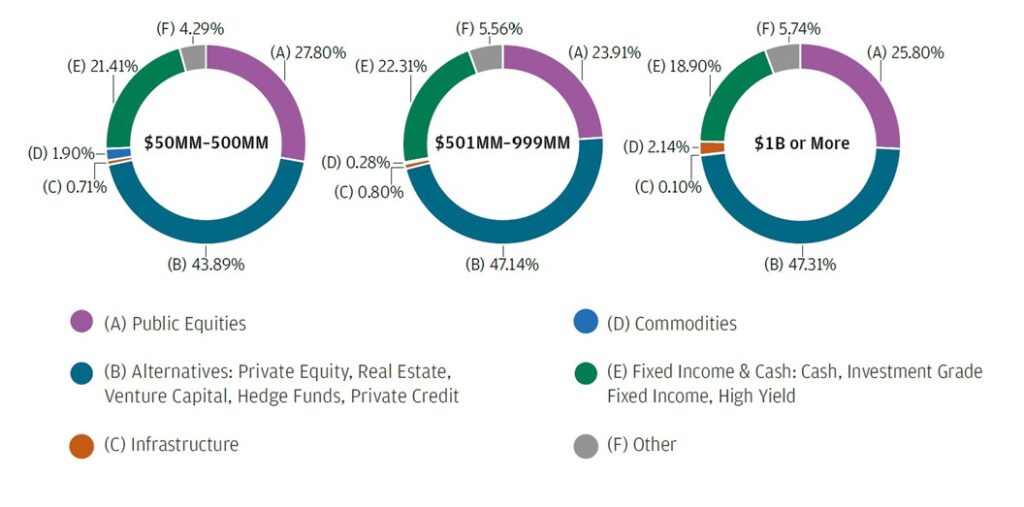
Alternative assets serve two purposes in a portfolio:
Return enhancement: Some alternatives (private equity, venture capital) offer higher expected returns than public markets, at the cost of liquidity.
Diversification: Others (private credit, real estate) have return drivers that don’t move in lockstep with public stocks and bonds.
At $100K, a 5–10% allocation to alternatives makes sense for most investors. Any less and the impact is noise; any more and liquidity constraints become a problem if you need cash quickly.
One hard rule: alternatives only enter the portfolio once you are debt-free. Private-market assets are illiquid by design; redemption windows, lock-ups, and quarterly liquidity are the norm. If you carry debt with fixed payment obligations, pairing it with assets you cannot readily sell is how investors get forced into bad decisions. Public markets first, private markets only on a fully clean balance sheet.
The Retail-Accessible Alternatives
Access to alternatives has changed dramatically in the last few years. You no longer need accredited investor status to get exposure. There are many more than the following three retail-accessible paths, however these three have been on my radar more than others:
Fundrise: Private real estate, private credit, and venture capital, all in one platform with a $10 minimum. Full details of my experience with Fundrise in One Year Investing in Fundrise: My 2025 Results and Takeaways, and if you want an additional $50 when you start investing with Fundrise.
PRIV (ETF): The first private credit ETF, a credit fund with exposure to private credit assets along with US treasuries, covered in depth in PRIV, the First Private Credit ETF on the Market.
RVI and VCX (ETFs): Private venture capital funds accessible through brokerage accounts, see Robinhood RVI vs. Fundrise VCX: The New Private Market ETFs.
Personal note: I’ve invested in Fundrise since 2025. After one year of real data, the experience matches what I expected, modest and uncorrelated returns that smooth out portfolio volatility. It’s not a get-rich product. It’s my diversification allocation that has performed great in 2026.
Step 6: Tax Strategies That Matter at $100K
At $100K, a few tax strategies start paying for themselves:
Tax-Loss Harvesting
In a taxable brokerage account, you can sell losing positions to offset capital gains elsewhere and deduct up to $3,000 of net losses against ordinary income each year. Any remaining losses carry forward indefinitely. Set a calendar reminder to review positions in late November each year.
Avoiding the Wash Sale Rule
If you sell a security at a loss, you can’t buy the same or a “substantially identical” security within 30 days before or after the sale, or the loss is disallowed. This trips up investors who sell VOO for a loss and immediately buy SPY, the IRS considers those substantially identical. The fix is to buy a different-enough fund like VTI, which tracks the total market instead.
Specific Lot Identification
When selling shares from a taxable account, instruct your broker to sell specific lots with the highest cost basis first (or the lots with losses for tax-loss harvesting). Most brokers default to FIFO (first in, first out), which often realizes the largest gains. Changing this setting can save meaningful tax dollars.
Qualified Dividend Holding Periods
To get the preferential qualified dividend tax rate (0%, 15%, or 20% depending on income), you must hold the stock for more than 60 days during the 121-day period around the ex-dividend date. Frequent trading inside a taxable account loses this benefit.
State Tax Considerations
If you live in a high-tax state like California, New York, or New Jersey, state taxes can add 5–13% to your investment income tax bill. Municipal bonds issued by your home state are often both federal and state tax-free. If you are allocating to bonds in a taxable account, I highly recommend taking a look at single name municipals or municipal bond funds for your state (if applicable). I’ve covered the California-specific math in How to Reduce Your Tax-Drag as a California Investor.
Step 7: The Mistakes to Avoid at $100K
After reaching this milestone, certain mistakes become disproportionately expensive. Watch for these:
1. Over-diversifying into too many funds. Five carefully chosen ETFs can provide all the diversification a $100K portfolio needs. Twenty overlapping funds create tax complexity and often hold the same underlying stocks anyway.
2. Confusing asset allocation with asset location. A 60/40 portfolio in all-taxable accounts can underperform a 60/40 portfolio with proper location by 0.5–1.5% annually. Over 30 years, that’s hundreds of thousands of dollars.
3. Paying off low-interest debt instead of investing. If you have a 3% mortgage, investing at an expected 7% return mathematically dominates paying extra on the mortgage. This is a behavioral, not a math, decision.
4. Chasing performance. The best-performing asset class of the last 12 months is rarely the best-performing asset class of the next 12. Asset allocation should reflect long-term expected returns, not recent performance.
5. Not rebalancing. Markets drift your portfolio away from your target allocation. Rebalance annually (or when any asset class drifts more than 5% from target) to lock in gains from winners and buy more of underperformers.
6. Ignoring the psychological side. At $100K, a 20% market drawdown is $20,000 — a meaningful amount of real money. Know your actual risk tolerance, not your self-perceived one.
What Changes After $100K, And What Doesn’t
A common claim online is that “your net worth explodes after $100K.” The data doesn’t support that cleanly, I’ve written about why in Your Net Worth Does Not Explode After 100K. The real story is more nuanced: compounding starts to show more, but your savings rate still matters more than your return for the first several years.
What changes after $100K:
Portfolio returns start generating meaningful dollar amounts. At 7%, you’re earning $7,000/year from market growth alone.
Tax efficiency becomes a real lever. An extra 0.5% in after-tax return on $100K = $500/year, growing with your balance.
Risk capacity expands. You can afford to take more volatility because you have a larger cushion.
What doesn’t change:
Your savings rate is still the biggest lever. A 1% higher savings rate still matters more than a 1% higher return for years to come.
Behavior is still 90% of the game. The investor who sells during downturns loses to the one who holds, regardless of account balance.
Simplicity still wins. A 3-fund portfolio still beats a 30-fund portfolio at $100K, $500K, and $1M.
For the long view of how $100K compounds into your next milestone, a popular article I have is: Growing a 100K Boglehead Portfolio to $1M Net Worth
Frequently Asked Questions
Can I just deposit $100K into my 401(k)?
No. 401(k) contributions can only come from payroll deferrals, there is no mechanism to transfer cash from a bank account into a 401(k). The workaround is the paycheck-substitution strategy in Step 2: raise your payroll deferral to the maximum and live off your cash to replace the reduced take-home pay. The economic result is identical to a direct contribution, with all the same tax benefits.
How should I invest $100K for passive income?
When I hear passive income, I assume someone is referring to dividends or distributions, so their focus should be on dividend growth ETFs (SCHD is a solid staple), REITs held in a Roth IRA for tax efficiency, an allocation to higher quality credit through a treasury or municipal bond fund, and for a higher yield an allocation to higher risk credit like the Fundrise private credit fund. A well-constructed income-focused $100K portfolio can realistically generate $3,500–$5,000 in annual income at a 3.5–5% yield. Full detail in How to Start an Income Portfolio with 100K Net Worth.
Please keep in mind, that your goal should be to continue to grow your capital rather than to use it or maximize tax exposure through distributions.
Should I pay off my mortgage or invest $100K?
If your mortgage rate is below 5%, the math strongly favors investing. A diversified equity portfolio has historically returned 7–10% annually, outpacing almost any mortgage rate. This is also does not account for mortgage deduction for US taxpayers which greater favors delaying paying off the mortgage. However, this is a personal decision, some investors value the peace of mind of a paid-off home more than the mathematical expected value.
What if I have a negative net worth?
If you are just starting your financial journey and just starting to build wealth, start habits that can help you build wealth. I have a post out for those building wealth from zero (or even lower), it is not something to be shameful about. It is something you can get out of, and you can build a positive net worth moving forward.
What percentage of my portfolio should be in alternatives?
For most retail investors at $100K, 5–10% in alternatives should be the max. Institutional portfolios go much higher (30–50%), but they have access to better vehicles and can tolerate more illiquidity. Alternatives should only be used once high interest debt is paid off and one’s overall portfolio and financial obligations are in a mature position.
Can I put $100K in SCHD alone?
You could, but you shouldn’t. SCHD is an excellent dividend growth ETF, but it has concentration in US large-cap value stocks. A diversified portfolio includes broad-market exposure (VOO/VTI), international equities, and non-equity asset classes. You should strive to have a balanced portfolio of non-correlated assets that should independently provide a positive expected return. The commonly cited 3 fund portfolio would be a better plan for balanced returns.
Is $100K enough to retire on?
No. $100K invested might generate $3,000–$4,000 per year using a 3–4% safe withdrawal rate, not nearly enough for most retirees. $100K is a milestone toward retirement, not a retirement target. Most financial planners target 25× annual expenses as a retirement number (so $40K/year expenses = $1M target).
Should I hire a financial advisor at $100K?
At $100K, the value of most advisors is limited, you are better off self-educating here. A fee-only fiduciary advisor for a one-time financial plan ($1,500–$2,000) can be valuable, however there are so many free resources that I highly recommend against hiring a financial advisor until managing your own money becomes too hard. Ongoing 1% AUM fees are impossible to justify at this level, 1% of $100K is $1,000/year, which meaningfully drags on returns over time.
How long until my portfolio reaches $500K?
Growing your net worth to $500K is a great goal, however you should aim to do it without burning yourself out. In truth, it will vary by how much you contribute to your current portfolio and your rate of return. A portfolio averaging a 7% return while you invest $1.5K a month will get you to $500K in about 11 years. For most people that is not a reasonable expectation, invest what you can in low-cost index funds, and you will reach your destination at the right time for you.
The Bottom Line
$100K is the milestone where your portfolio stops being a savings account and starts being a wealth-building engine. But it’s also the point where mistakes compound, tax inefficiency, poor asset location, and under-diversification all start costing real dollars.
The playbook is:
Clear the runway: Emergency fund carved out, high-interest debt eliminated.
Deploy cash where it’s accepted: IRA first ($7,500 each, backdoor if needed), HSA if eligible, spousal IRA if married, direct transfers, done in a day.
Run the paycheck substitution: Max your 401(k) deferral (and mega backdoor Roth if your plan allows) and live off the cash. This is how the bulk of your $100K reaches tax-advantaged space.
Place assets in the right accounts: Bonds and REITs in tax-deferred, broad equity ETFs in taxable, highest-growth in Roth.
Build a diversified allocation: US equities, international, dividend growth, bonds, cash, aligned with your age and risk tolerance.
Add 5–10% in alternatives, only once debt-free: Private real estate, private credit, and venture exposure through Fundrise, PRIV, or similar platforms.
Execute the tax strategies: Tax-loss harvesting, specific lot identification, state-specific municipal bonds.
The goal isn’t to pick the “perfect” portfolio. It’s to build one that’s tax-efficient, appropriately diversified, and durable enough to hold through volatility for the next several decades. At $100K, you have more than enough capital to do that right.
This article was written by a licensed CPA and is for general educational purposes only. It is not personalized financial, tax, or investment advice. Consult a qualified financial professional before making investment decisions regarding your specific situation. [Read the full disclaimer.]