
Building wealth from zero starts with three blocks laid in order: establish credit efficiently, create excess cash flow with a simple budget, then invest the surplus into a broad index fund like VOO through a low-cost brokerage.
This guide assumes you are just starting to build wealth, you may be at $0 net worth, or you may have debt creating a negative net worth. Either way, the goal will be to get you into a better position financially.
I’m a licensed CPA, and I’ll tell you the same thing I’d tell my friends trying to build wealth: wealth at this stage is not about picking stocks. It’s about building the process that produces investable dollars every month. The portfolio comes later, and when it does, it exists to serve your life goals, not the other way around.
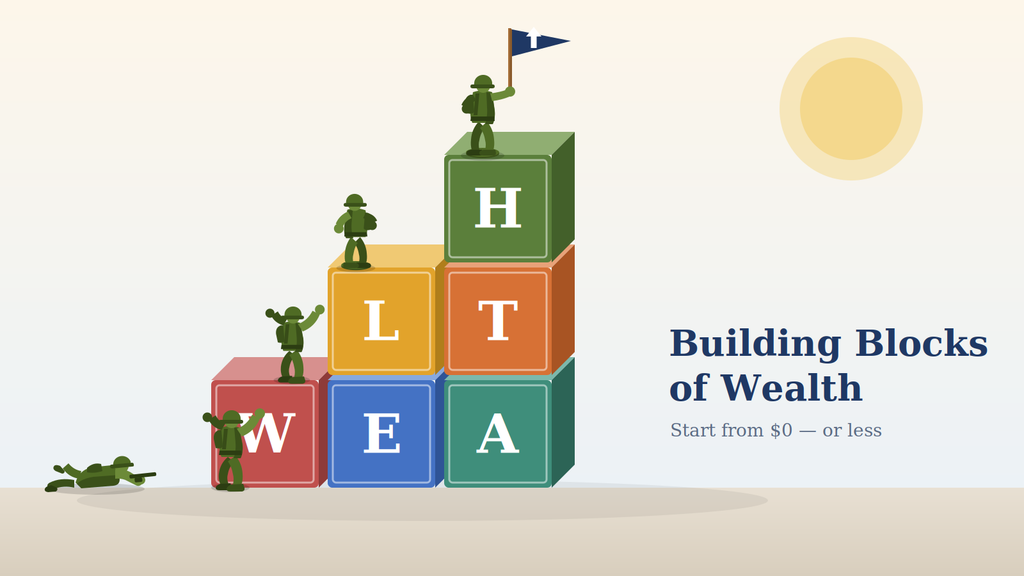
Here’s the full blueprint.
First, Know Your Number (Even If It’s Negative)
Your net worth is everything you own minus everything you owe. If that number is negative, you’re not broken, you’re normal. A new graduate with $30,000 in student loans and a used car may have a negative net worth, but it is a perfectly good position to start building wealth moving forward.
Calculate it once, write it down, and check it monthly. That single habit, watching one number move, does more for financial behavior than any app or spreadsheet. Try this Free Net Worth Tracker to get started so you can visualize your net worth month over month.
Block 1: Credit, Build It Before You Need It
Credit is the cheapest building block and the one most beginners get backwards. Used badly, credit cards are the single biggest wealth destroyer for young households. Used correctly, a credit card is a free credit-score machine that costs you nothing and quietly builds your financial reputation for years.
Why your credit score is a wealth number
Your score determines what you’ll pay to borrow for the things that actually build net worth, a mortgage is the loan you will have for buying a home, real estate has historically been a good way to build wealth in America. A weak score can cost tens of thousands of dollars in extra interest over the life of a home loan. Building the score now, before you need it, is one of the highest-ROI moves available to someone starting from zero.
Two factors drive roughly 65% of your FICO score:
| Factor | Weight | What it means for you |
|---|---|---|
| Payment history | 35% | Never miss a payment. Ever. Automate it. |
| Credit utilization | 30% | Keep balances tiny relative to limits (under 10% is ideal) |
| Length of credit history | 15% | Open your first account early—the clock starts now |
| Credit mix | 10% | Comes naturally over time; ignore for now |
| New credit | 10% | Don’t apply for five cards at once |
The set-and-forget method (I actually did this)
Here’s the exact strategy I used to build credit without ever risking a late payment or an interest charge:
- Open one starter credit card. I used the Discover it® card, it’s beginner-friendly, has no annual fee, and Discover currently offers a $100 statement credit for new card members.
- Put exactly one recurring subscription on it. Netflix, Spotify, your phone bill, one small, predictable charge.
- Set up autopay for the full statement balance. Not the minimum. The full balance, every month, automatically.
- Put the card in a drawer. You never swipe it. You never think about it.
That’s the whole system. A ~$15 subscription on a $1,000 limit is 1.5% utilization, which is excellent. Autopay makes your payment history perfect by default. The account ages in the background, and your score climbs while you focus on the other two blocks.
This is one of several ways to build credit from scratch, secured cards, authorized-user status, and credit-builder loans all work too. As you build your credit, you will not feel like you are building wealth today, you are preparing for long term wealth when it is time to buy a home.
The one rule that overrides everything
If you can’t trust yourself to leave the card in the drawer, don’t open it. A credit card carrying a revolving balance at today’s APRs will outrun any investment return you can realistically earn (Federal Reserve data puts average rates on interest-bearing card accounts north of 20%). The set-and-forget method only works because it removes the temptation entirely.
Block 2: Budgeting Your Income
You cannot invest money that doesn’t exist. The entire purpose of a budget is to create a cash flow gap: the monthly surplus between what you earn and what you spend. That gap is the raw material of wealth. Everything downstream, the emergency fund, the debt payoff, the portfolio, is funded by it.
Start with 50/30/20
The simplest durable framework splits take-home pay three ways: 50% to needs, 30% to wants, 20% to saving and debt payoff beyond minimums.
| Monthly take-home | Needs (50%) | Wants (30%) | Save + extra debt (20%) |
|---|---|---|---|
| $3,000 | $1,500 | $900 | $600 |
| $4,000 | $2,000 | $1,200 | $800 |
| $5,000 | $2,500 | $1,500 | $1,000 |
The percentages are a starting point, not scripture. In a high-cost state like California, needs may run 60%+ at first, as someone who lives in California currently, I get how expensive it is. The goal is simply that the third bucket exists and grows over time.
The starter emergency fund
Before a single dollar goes to investing, park $1,000–$2,000 in a high-yield savings account. This isn’t your full emergency fund, that comes later, at 3–6 months of expenses. This is the shock absorber that keeps a flat tire or an urgent care bill from landing on the credit card and undoing Block 1.
Kill high-interest debt first (the guaranteed return)
Here’s the math on why credit card debt comes before investing. A $5,000 balance at 24% APR, paid at $150/month, takes 56 months to clear and costs $3,322 in interest. Bump the payment to $250/month and it’s done in 26 months with $1,449 in interest, paying faster “earned” you nearly $1,900, guaranteed and tax-free.
Compare the alternatives on the same $1,000:
| Where the $1,000 goes | One-year result |
|---|---|
| Sits on a card at 24% APR | ~ –$240 in interest charges |
| Invested at an 8% assumed return | ~ +$80 expected (not guaranteed) |
Paying off a 24% debt is a 24% risk-free return. No investment offers that. My ordering: high-interest debt (7% APR or greater) gets destroyed first; low-rate debt like federal student loans can be paid on schedule while you invest.
As you budget and pay off high interest debt, you will quickly see the effects from your actions as it pertains to your net worth. Building wealth from zero or a negative net worth can be difficult, but by paying off your debts you rapidly remove the items pushing your net worth down.
Block 3: Investing, Putting Your Capital to Work
With credit automated, a cash flow surplus created, a starter fund parked, and expensive debt dying, the surplus finally has a job: buying assets.
The order of operations
As a CPA I’d be doing you a disservice if I didn’t give you the tax-aware sequence:
- 401(k) up to any employer match — it’s a 50–100% instant return; nothing beats free money.
- Roth IRA and/or taxable brokerage — the Roth gives tax-free growth; the taxable account gives total flexibility (no income limits, no early-withdrawal penalties, money accessible for any life goal at any time).
- Back to the 401(k) beyond the match as income grows.
For someone starting from zero, I like the taxable brokerage account for one behavioral reason: accessibility removes the biggest beginner objection, “what if I need the money?” You can always add tax-advantaged layers later. What you can’t recover is years of not investing at all.
What to actually buy: one fund
Skip stock picking entirely. Buy a broadly diversified S&P 500 index fund, VOO (Vanguard S&P 500 ETF) is my default choice, and keep buying it every month. One fund gives you ownership of 500 of the largest American companies at a rock-bottom expense ratio. Historical U.S. equity returns have averaged roughly 10% annually over the last century; I use a more conservative 8% in projections below.
Why this beats picking stocks for beginners: at this stage your savings rate matters vastly more than your investment selection. On a $5,000 portfolio, a brilliant year of stock picking that beats the market by 5% earns you $250. Adding $200/month adds $2,400. Focus on the contributions first; the market does the rest.
What consistent investing actually builds
All figures assume an 8% annual return, compounded monthly:
| Monthly investment | 5 years | 10 years | 20 years | 30 years |
|---|---|---|---|---|
| $100 | $7,348 | $18,295 | $58,902 | $149,036 |
| $200 | $14,695 | $36,589 | $117,804 | $298,072 |
| $300 | $22,043 | $54,884 | $176,706 | $447,108 |
| $500 | $36,738 | $91,473 | $294,510 | $745,180 |
And the first milestone, your first $10,000 invested, is closer than it feels:
| Monthly investment | Time to $10,000 |
|---|---|
| $100 | ~6.4 years |
| $200 | ~3.7 years |
| $300 | ~2.6 years |
| $500 | ~1.6 years |
The pattern to internalize: the first $10K is almost entirely your contributions. The compounding takes over later, which is exactly why starting now matters more than starting big.
Where to open the account
For a first brokerage account I recommend SoFi Invest: no commissions, no account minimums, fractional shares (so you can buy VOO with whatever the surplus is this month), automatic recurring investments, and IRAs on the same platform when you’re ready for step 2 of the order of operations.
Open a SoFi Invest account through this link and get $25 in free stock to start. Set up a recurring buy of a broad market ETF of your choice on payday and let your portfolio start to build. I bought VOO with my account opening bonus and add to my position with every paycheck.
Once your debts are gone and you have no liabilities and no financial assets, building wealth from zero is simply just investing. I have a breakdown of
What NOT to Do Yet
A note on discipline, because you’ll be marketed to relentlessly:
- No alternative investments yet. Real estate crowdfunding, private credit, crypto, art, some of these have a real place in a mature portfolio (I invest in several and write about them extensively, check it out once you are ready). None of them belong in a portfolio under $100K or as long as you have high interest debt. Master the boring foundation first.
- No individual stock picking. See the math above.
- No leverage, no options, no margin. You’re building; these are tools for a later stage, if ever.
The passive foundation comes first. The active layer is earned.
The Handoff: From Zero to the First $100K
Once the three blocks are laid, credit automated, gap widening, index fund growing, you graduate to the next phase of the journey: the road to your first $100,000. That milestone changes everything about how your money works, and it’s where most people check out the Portfolio Literacy blog: What to Do With $100K: The Complete Guide for US Investors in 2026. The compounding math behind why $100K is a commonly referenced inflection point is here: Your Net Worth Does Not Explode After 100K.
Your net worth number, the one you wrote down at the top of this article, should start moving upward as you follow this guide. Check it monthly to watch the growth and appreciate what you are building. Building wealth from zero feels hard but in reality, as you work towards building your net worth in increases the fastest when starting from zero (or lower) because all gains are meaningful.
Frequently Asked Questions
Should I pay off debt or start investing first?
It depends entirely on the interest rate, and the dividing line sits around 7–8%.
Debt above that threshold, credit cards at 20%+, personal loans, many auto loans, should be destroyed before you invest a dollar. Paying off a 24% balance is a guaranteed, tax-free 24% return, and no diversified portfolio offers that. Below the line, the math flips: federal student loans at ~5% can be paid on schedule while you invest, because an expected 8% return beats a 5% guaranteed one over a long horizon.
The one exception in both directions: always capture a 401(k) employer match first, even while carrying high-interest debt. A 50% match is an instant 50% return that outruns any credit card APR.
How much money do I need to start investing?
Honestly, it could be as little as $1. Fractional shares let you buy a slice of an index fund at any dollar amount, so there’s no minimum to clear before you begin.
The number that actually matters isn’t your starting balance; it’s your monthly contribution. Even $50 a month at an assumed 8% return grows to roughly $9,100 in 10 years and $74,500 over 30. Starting small and being consistent beats waiting until you can start big. Open the brokerage account, set the recurring buy, and raise the amount as your income grows.
Should I open a credit card if I’m bad with money?
No. That honesty with yourself will save you thousands.
A credit card is only a wealth tool if you never revolve a balance. If you’ve carried one in the last year, or if spending on a card feels different than spending cash, build the other two blocks first: get the budget working, get the starter emergency fund funded, then revisit. A secured card with a small deposit is the safer on-ramp when you’re ready.
When you are ready, the set-and-forget method is designed specifically to remove temptation: one card, one subscription, autopay in full, and the card physically stays in a drawer. It builds a decade of payment history without ever putting the card in your wallet.
Do I need a financial advisor to start?
No. At this stage the entire strategy fits on an index card: automate the credit card, open the cash flow gap, buy a broad index fund every payday.
Ongoing 1% AUM fees are impossible to justify on a small balance, and most of what an advisor would tell you at this level is freely available, including on this site. A one-time session with a fee-only fiduciary planner can be worth it if your situation has genuine complexity (equity compensation, a business, a divorce), but “I’m starting from zero and want to do this right” is not complexity. It’s a checklist.
When can I start investing in real estate, crypto, or private markets?
Once the foundation is genuinely built, typically somewhere north of a $100K portfolio, with high-interest debt at zero and a full emergency fund in place.
I write extensively about alternatives and hold them in my own portfolio, so this isn’t skepticism about the asset class. It’s sequencing. Private-market investments are illiquid by design, some have lock-ups or quarterly redemption windows, and pairing illiquid assets with a thin cash cushion is how people get forced into bad decisions at the worst moment. Public markets first, private markets on a clean balance sheet.
Illustrative projections assume an 8% annual return compounded monthly and are not a guarantee of future results. Historical return data referenced from NYU Stern (Damodaran) long-run return series; consumer credit rate data from the Federal Reserve (FRED, series TERMCBCCALLNS).
I’m a licensed CPA, but I’m not your CPA. This article is educational content, not individualized tax, legal, or investment advice. Consult a qualified professional about your specific situation.
Disclosure: This article contains affiliate links for SoFi and Discover. If you open an account through these links, I may receive compensation at no cost to you. I only recommend products I have personally used. Offer terms ($25 SoFi stock bonus, $100 Discover statement credit) are set by the issuers and subject to change, verify current terms before applying.
Comments
One response to “Building Wealth from Zero Using the Building Blocks of Wealth”
[…] starting to build wealth, start habits that can help you build wealth. I have a post out for those building wealth from zero (or even lower), it is not something to be shameful about. It is something you can get out of, and you can build a […]