
The annual reconstitution of Schwab U.S. Dividend Equity ETF (SCHD) is one of the most important structural events for investors focused on dividend growth and quality factor exposure. While many investors treat SCHD as a “set-and-forget” income vehicle, the underlying mechanics of its index—Dow Jones U.S. Dividend 100 Index—are highly systematic, rules-based, and materially impactful to portfolio composition, factor tilts, and forward return expectations. This post breaks down the SCHD reconstitution process at a technical level, analyzes how it reshapes the portfolio each year, and evaluates the implications for investors using SCHD as a core equity allocation.
What Is the SCHD Reconstitution?
Reconstitution is the annual process by which the underlying index refreshes its holdings based on updated financial data, eligibility criteria, and factor scoring.
For SCHD, this occurs once per year (typically announced in March and implemented shortly thereafter), and involves three key steps:
- Universe Screening
- Fundamental Ranking
- Portfolio Construction & Weighting
This is not a passive “market-cap drift” like the S&P 500. It is an actively rules-based factor selection process disguised within an ETF wrapper.
Step 1: Universe Screening (Eligibility Filter)
The starting universe is large-cap U.S. equities, but not all dividend-paying stocks qualify. Companies must meet strict criteria:
- Minimum 10 consecutive years of dividend payments
- Listed on major U.S. exchanges
- Adequate liquidity (trading volume thresholds)
- Exclusion of REITs (important structural decision)
Implication:
This immediately filters out:
- High-yield but unstable payers
- Early-stage dividend growers
- Most real estate income vehicles
This creates a bias toward mature, cash-flow-generative companies.
Step 2: Fundamental Ranking System
Eligible companies are then scored across four fundamental metrics:
Cash Flow to Total Debt
Measures balance sheet strength and ability to service obligations.
Return on Equity (ROE)
Captures capital efficiency and profitability quality.
Dividend Yield
Reflects current income level.
5-Year Dividend Growth Rate
Captures consistency and growth of shareholder returns.
Each company receives a composite score, and the top 100 companies are selected.
Key Insight:
This is not a pure “high yield” strategy. It is a multi-factor quality + income model, which explains why SCHD often avoids yield traps.
Step 3: Weighting Methodology
Once selected, holdings are weighted using a modified market-cap approach with constraints:
- Cap per stock: ~4%
- Sector diversification limits
- Tilt toward larger, more stable companies
Result:
You get a portfolio that:
- Avoids concentration risk (unlike cap-weighted indices)
- Still reflects economic scale
- Prioritizes dividend sustainability over raw yield
What Actually Changes with the 2026 SCHD Reconstitution?
Each year, three types of changes occur:
Additions
New companies that meet the criteria and score highly enter the index.
Deletions
Companies are removed due to:
- Dividend cuts or stagnation
- Deteriorating fundamentals
- Falling below ranking thresholds
Weight Adjustments
Existing holdings are reweighted based on updated scores and constraints.
Below is a reflection of the removals and additions from r/SCHD.
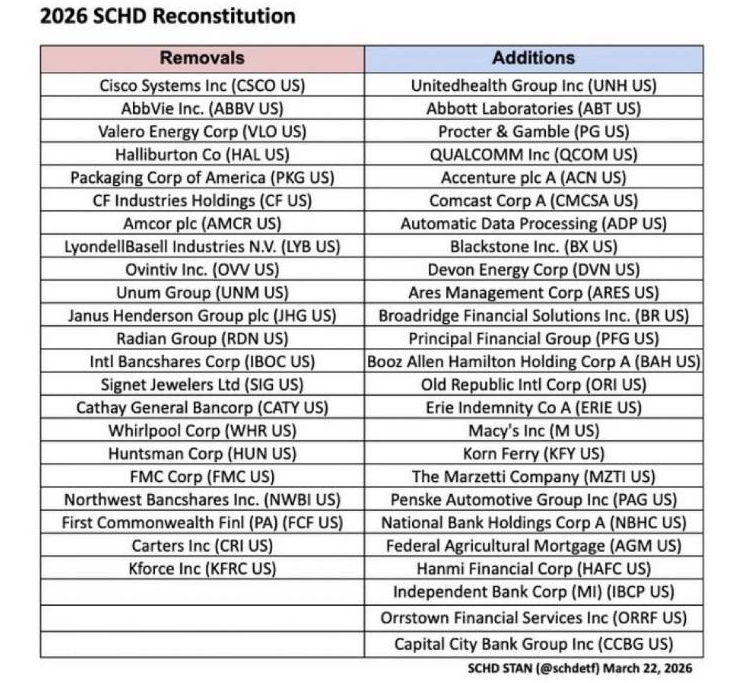
Historical Patterns in SCHD Reconstitution
Over time, SCHD reconstitutions tend to show consistent structural tendencies:
Removal of Weakening Dividend Stories
Companies experiencing:
- Margin compression
- Rising leverage
- Slowing dividend growth
…are systematically removed.
Addition of Improving Balance Sheets
Firms with:
- Strengthening free cash flow
- Deleveraging
- Accelerating dividend growth
…are added or upweighted.
Sector Rotation (Implicit, Not Tactical)
While SCHD does not explicitly target sectors, the methodology often results in shifts:
- Increased weight to industrials, financials, and healthcare when fundamentals improve
- Reduced exposure to cyclical or deteriorating sectors
Why the SCHD Reconstitution Matters for Investors
It Is the Source of SCHD’s Alpha
The annual refresh prevents:
- Holding “fallen angels” indefinitely
- Yield traps from dominating the portfolio
Instead, SCHD systematically rotates into higher-quality income streams.
It Reduces Long-Term Risk
Because companies must continuously meet quality thresholds, SCHD naturally:
- Avoids excessive leverage exposure
- Filters out deteriorating business models
- Maintains strong aggregate balance sheet quality
This is a key reason SCHD often exhibits lower volatility relative to broad equity indices.
It Impacts Dividend Growth Trajectory
Reconstitution directly influences:
- Forward dividend yield
- Dividend growth rate
- Income stability
For example:
- Adding high-growth dividend companies → increases future income growth
- Removing stagnant payers → improves portfolio quality
Turnover and Tax Efficiency
Despite annual reconstitution, SCHD maintains relatively low turnover (~10–20% historically).
Why this matters:
- Lower transaction costs
- High tax efficiency (critical for taxable accounts)
- Stability in portfolio composition
This is a key advantage versus more actively managed dividend strategies.
Comparing the SCHD Reconstitution to Other ETFs
SCHD vs S&P 500 ETFs (e.g., VOO)
- S&P 500: Market-cap driven, minimal reconstitution impact
- SCHD: Factor-driven, meaningful annual reshaping
SCHD vs High-Yield ETFs
- High-yield ETFs: Often static and yield-focused
- SCHD: Dynamic and quality-focused
SCHD vs Dividend Aristocrats
- Aristocrats: Based on dividend streak alone
- SCHD: Multi-factor selection beyond just streak length
Strategic Implications for Portfolio Construction
For investors building portfolios, SCHD’s reconstitution process provides:
Built-in Quality Control
You are outsourcing fundamental screening to a rules-based system.
Dynamic Factor Exposure
SCHD continuously adjusts exposure to:
- Profitability
- Balance sheet strength
- Dividend growth
Reduced Need for Active Monitoring
Because weak companies are removed automatically, SCHD functions as a self-maintaining dividend portfolio.
Risks and Limitations of Reconstitution
While the process is robust, it is not without trade-offs:
Lagging Signals
Reconstitution is annual, meaning:
- Deterioration may not be captured immediately
- Improvements may take time to be reflected
Backward-Looking Metrics
The methodology relies on historical data:
- Past dividend growth
- Historical ROE
This may miss forward-looking inflection points.
Sector Bias Risk
Because selection is rules-based:
- Certain sectors may dominate unintentionally
- Cyclicality can still influence outcomes
Final Takeaway
The SCHD reconstitution is not just a maintenance event, it is the core engine driving the ETF’s long-term performance characteristics.
By combining strict eligibility criteria with a multi-factor ranking system, SCHD continuously refines its exposure to:
- High-quality companies
- Sustainable dividends
- Strong balance sheets
For investors, understanding this process is critical. It explains why SCHD behaves differently than traditional equity ETFs and why it has historically delivered a compelling mix of income, growth, and risk management.
If you are using SCHD as a foundational position in your portfolio, the annual reconstitution is the single most important structural event to monitor—not because you need to act on it, but because it defines what you own going forward.
Disclaimer:
This post contains mentions of publicly traded securities. This post is not a recommendation to buy, sell, or trade said securities. Please visit my personal portfolio to see my financial positions for clarity of my biases or inclinations.